Carbohydrates
- Organic
- Made up of carbon, hydrogen and oxygen
- Ususaly
- Ratio of hydrogen to oxygen is 2:1
- Provides energy for cellular activities
- Form supporting structures
- Form nucleic acids
Simple Sugars (monosaccharides)
- Small molecules which cannot be further digested and can pass through plasma (cell surface) membrane
- All simple sugars are reducing sugars
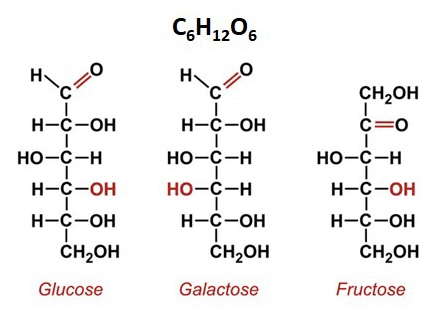
- Eg: Glucose, Fructose, Galactose
- Looks like hexagon/pentagon
Structure:
Double Sugars (disaccharides)
- Two monosaccharides are chemically bonded together to form disaccharides by a condensation reaction
- CANNOT PASS THROUGH PLASMA MEMBRANE
- Eg: Maltose, Lactose, Sucrose
- Maltose and Lactose are reducing sugars, Sucrose is non-reducing sugar
- Reactions:
- Glucose + Glucose -> Maltose + Water
- Glucose + Fructose -> Sucrose + Water
- Glucose + Galactose -> Lactose + Water
+ -> + - THESE REACTIONS CAN ALSO BE REVERSED
- A glycosidic/ether bond (C-O-C) is formed between two monosaccharides
Complex Sugars (polysaccharides)
- Complex carbohydrates
- Many single sugars combined by condensation reactions
- Eg: Starch, glycogen, cellulose
- made of many glucose molecules
- Linked differently
- Different structure = different properties
Starch
- Branched macromolecules, making it compact
- Made of several thousand glucose molecules
- In long helix chains
- Function:
- Store carbohydrates in plants
- Found in storage organs
Glycogen
- Branched macromolecules, making it compact
- Made of many glucose molecules arranged in short helical chains with many branches
- Function
- Stores carbohydrates in animals
- Insoluble
- Digested to glucose
- Stored in liver and muscles of animals
Cellulose
- Unbranched macromolecules
- Cannot be easily digested
- Glucose molecules in long straight chains, giving them high tensile strength
- Present in cell walls of plants
Reducing Sugars
- Gives electrons to other end
- Can be tested with Benedict’s Test