Electric current
- charges move
- Conventional current flow:
- Current move from positive to negative
- Actual current flow:
- Electrons move from negative to positive
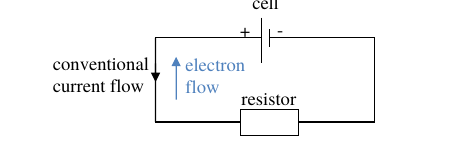
- Electrons move from negative to positive
- Unit for current is Ampere (A)
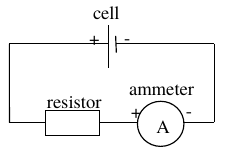
- Ammeter used to measure current
- Must be connected in series to circuit
- Should have 0 resistance to current flow
- Ammeter used to measure current
Ammeter setup:
Potential Difference and Electromotive Force
- Potential Difference (p.d.) -> work done to drive a unit charge through the component
- Electromotive Force (e.m.f) -> work done by the source to drive a unit charge around a complete circuit
- Unit for p.d. and e.m.f is Volt (V)
- e.m.f. is the amount of electrical energy produced by a source while p.d. is the electrical energy converted to other forms of energy when a unit positive charge moves from one point to another in a component
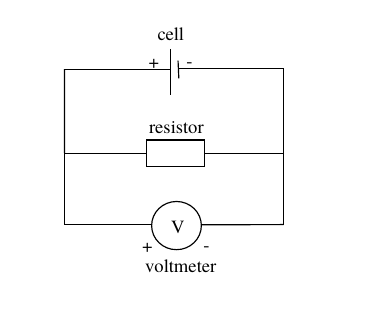
- Voltmeter used to measure p.d.
- Must be connected in parallel
- Should have infinite resistance
Voltmeter setup:
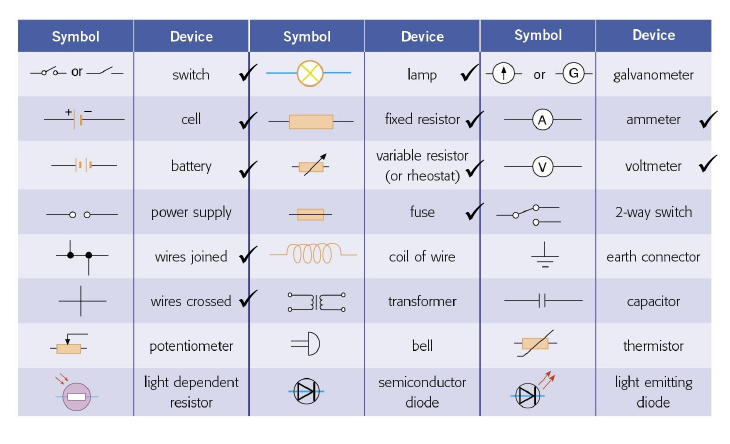
Electrical Symbols
Resistance
- Ratio of Potential Difference across it to the current flowing through it
- Hinders flow of charge
- Formula:
- S.I. unit is ohm (
) - Used to control the size of current flowing in a circuit
| Fixed resistor | Variable resistor |
|---|---|
| fixed value of resistance | variable resistance |
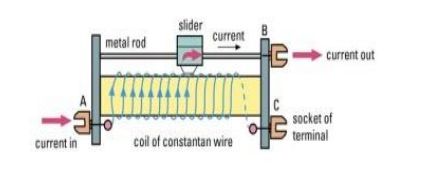
| e.g. carbon film resistors, carbon composition resistors, tin oxide resistors, wire-wound resistors | e.g. rheostat |
Diagram of how rheostat works:
Effective Resistance
Resistors connected in series
- Resistance of multiple resistors can be combined into one singular large resistor
- Effective resistance of
resistors:
- Current in series circuit is constant
- Voltage of source:
Resistors in parallel
- p.d. of resistors are the same
- Effective resistance of
resistors: - Current:
Electrical Power
Formula for power:
- S.I. unit is watt (W)
- Watt = J/s
Amount of electrical energy used: